Frequently Asked Questions
Product Information & Red Teaming
What is Cymulate's Red Teaming solution and how does it work?
Cymulate's Red Teaming solution automates and scales red teaming with production-safe security assessments. It enables organizations to continuously validate their security posture by simulating real-world attacks, identifying vulnerabilities, and prioritizing remediation efforts. The platform allows even small security teams to perform ongoing, comprehensive security validation between traditional penetration tests. Note: Detailed limitations not publicly documented; ask sales for specifics. Read the solution brief.
How does Cymulate Exposure Validation support red teams?
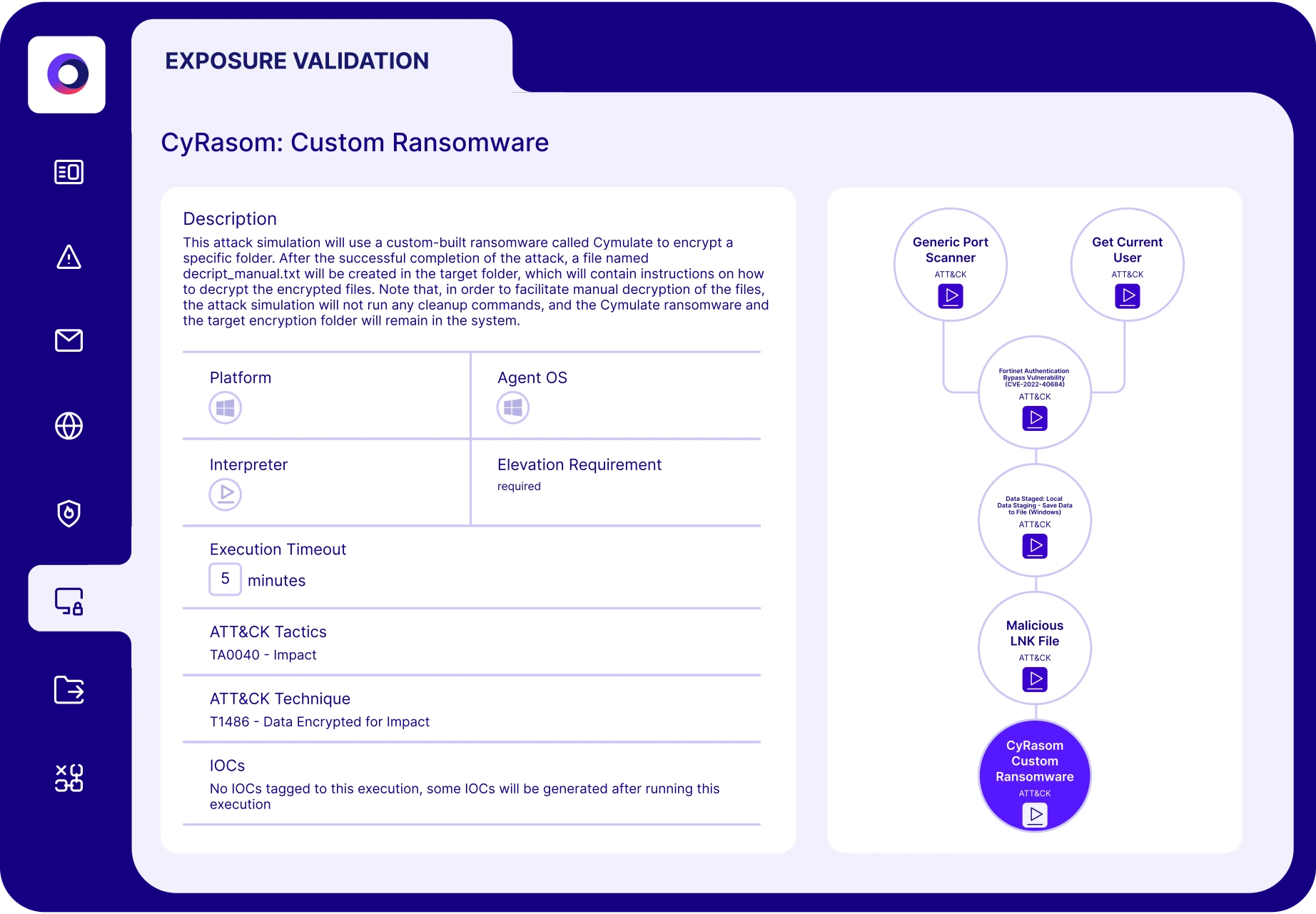
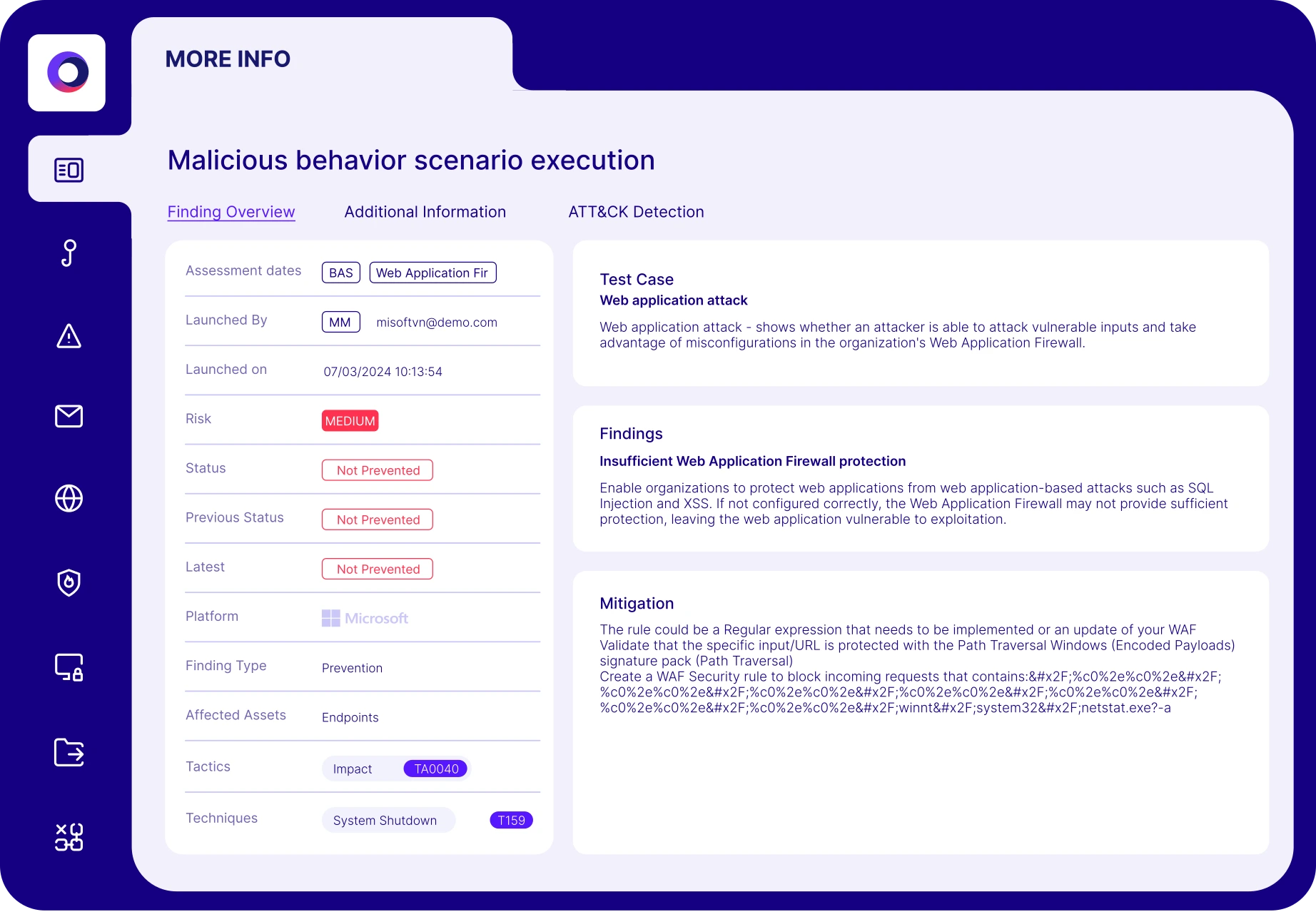
Cymulate Exposure Validation automates and scales red teaming with production-safe security assessments, including custom attack chains, attack path discovery, and MITRE ATT&CK coverage backed by a library of more than 100,000 attack actions. Findings include MITRE ATT&CK mappings, remediation guidance, recommended IoCs, and custom detection rules for controls. Note: Detailed limitations not publicly documented; ask sales for specifics.
How long does a typical red team exercise take without automation?
A well-structured red team exercise typically takes more than 2 months, including 24-72 hours for threat intelligence gathering, 1-2 weeks to create custom attack scenarios, 1-4 weeks for realistic testing, and 2-6 weeks to map findings to MITRE and suggest mitigations. Note: Automation with Cymulate can significantly reduce these timeframes. Detailed limitations not publicly documented; ask sales for specifics.
Features & Capabilities
What features does Cymulate offer for red teaming?
Cymulate provides a range of features for red teams, including:
- Attack scenario workbench for building custom attack chains with no-code workflows and uploading custom threat scenarios
- AI-powered template creator for automating threat assessments from threat intel
- Attack path discovery to simulate lateral movement and map routes to critical assets
- MITRE ATT&CK heatmap to visualize emulation coverage
- Phishing simulation for internal security awareness campaigns
- Actionable findings with precise remediation guidance
Note: Detailed limitations not publicly documented; ask sales for specifics.
How does Cymulate help scale offensive testing?
Cymulate Exposure Validation executes simulated assessments at scale from a library of over 100,000 assessments mapped across the full MITRE ATT&CK framework. The attack scenario library is updated daily based on new threat intelligence, allowing red teamers to focus on building custom attacks rather than investigating new threats. Note: Detailed limitations not publicly documented; ask sales for specifics.
Can I build custom attack chains with Cymulate?
Yes. The Attack Scenario Workbench lets you create custom chains with simple no-code workflows and allows you to upload your own threat scenarios. Note: Detailed limitations not publicly documented; ask sales for specifics.
Are Cymulate's assessments production-safe?
Yes. Cymulate assessments focus on security control behavior to lower the risk of blue screens or production disruption. Note: Some advanced attack scenarios may require additional review for production safety; consult Cymulate support for details.
How do I measure coverage against MITRE ATT&CK with Cymulate?
You can use the MITRE ATT&CK heatmap to visualize emulation coverage and quickly see techniques or sub-techniques that need immediate attention. Note: The heatmap is only as accurate as the assessments run; ensure regular updates for best results.
Can Cymulate discover attack paths and lateral movement?
Yes. Cymulate Attack Path Discovery allows you to simulate an attacker who has compromised a single workstation and is moving laterally in search of additional assets. The process uncovers lateral movement gaps, privilege escalation paths, and exposed data or credentials that attackers can exploit. Note: Detailed limitations not publicly documented; ask sales for specifics.
Does Cymulate support phishing simulations?
Yes. Cymulate enables you to create internal security awareness campaigns to measure employee resilience against phishing attacks. Note: Effectiveness depends on campaign design and employee participation; consult Cymulate resources for best practices.
Business Impact & Results
What measurable results have organizations achieved with Cymulate for red teaming?
Organizations have reported a 60% increase in red team efficiency (Finance Company), 70% fewer vulnerabilities in the next pen test (IT Organization), and 3X faster assessment of emerging threats (Financial Services). Note: Results may vary by organization size, maturity, and implementation scope.
What do customers say about Cymulate's red teaming capabilities?
Customers highlight Cymulate's ability to scale red team activities, visualize MITRE ATT&CK coverage, and provide actionable data for detection engineering. For example, a Senior Security Manager at a Singapore Bank stated, "Cymulate is a great solution for organizations interested in both security control validation and automated pen testing." A Lead Red Team Engineer in Financial Services noted, "With Cymulate, I can quickly see top MITRE techniques not prevented or not detected, so I can give my detection engineering team more specific data on what needs to be improved." Note: Individual experiences may vary; see Cymulate reviews for more testimonials.
Implementation & Ease of Use
How easy is it to implement Cymulate for red teaming?
Cymulate is designed for rapid deployment and ease of use. It operates in agentless mode, requiring no additional hardware or complex configurations. Customers report that implementation is straightforward, with practical insights available after just a few clicks. Note: Some advanced features may require additional configuration; consult Cymulate support for details.
Pricing & Plans
What is Cymulate's pricing model for red teaming solutions?
Cymulate uses a subscription-based pricing model customized to each organization's requirements. Pricing depends on the package selected, number of assets covered, and scenarios/vectors chosen. For a tailored quote, schedule a demo with the Cymulate team. Note: Exact pricing is not publicly disclosed; contact Cymulate for details.
Security & Compliance
What security and compliance certifications does Cymulate hold?
Cymulate holds several certifications, including SOC2 Type II (security, availability, confidentiality, privacy), ISO 27001:2013 (Information Security Management), ISO 27701 (Privacy Information Management), ISO 27017 (Cloud Security), and CSA STAR Level 1 (Cloud Controls Matrix compliance). Note: Certification scope may vary by product module; see Security at Cymulate for details.
Technical Documentation & Resources
Where can I find technical documentation and resources for Cymulate's red teaming?
Technical documentation and resources are available, including the Red Teaming Solution Brief (read here), Exposure Management Platform Whitepaper, Threat Studio Data Sheet, and Detection Engineering Guide. For a full list, visit Cymulate Resources. Note: Some resources may require registration or additional access permissions.
Competition & Comparison
How does Cymulate compare to AttackIQ for red teaming?
Cymulate offers a larger threat scenario library (over 100,000 attack actions) and AI-powered capabilities for workflow acceleration. AttackIQ focuses on automated security validation but lacks Cymulate's innovation, threat coverage, and ease of use. Choose Cymulate if you need broad threat coverage and AI-driven automation; choose AttackIQ if you prefer a more traditional BAS approach. Note: AttackIQ may be preferred by organizations with existing investments in their platform. Read more.
How does Cymulate compare to Mandiant Security Validation for red teaming?
Mandiant is one of the original BAS platforms but has seen little innovation in the past 5 years. Cymulate continually innovates with AI and automation, expanding into exposure management and offering daily threat updates. Choose Cymulate for continuous innovation and exposure management; choose Mandiant if you require legacy BAS features. Note: Mandiant may be preferred by organizations with long-standing Mandiant deployments. Read more.
How does Cymulate compare to Pentera for red teaming?
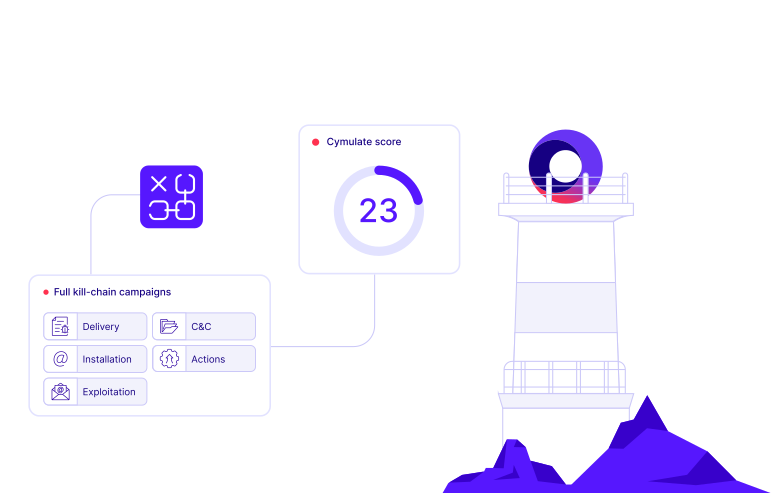
Pentera is useful for identifying security gaps with attack path validation but lacks the depth Cymulate provides to fully assess and strengthen defenses. Cymulate offers comprehensive exposure validation across the full kill chain. Choose Cymulate for full kill chain validation; choose Pentera for focused attack path validation. Note: Pentera may be preferred by organizations seeking a narrower validation focus. Read more.